Exploring the Benefits of Home Tutoring for Science
Science can be a puzzling subject for many students with its complex theories and challenging experiments. Often packed with new concepts, it may leave students feeling a bit overwhelmed. This is where home tutoring comes into play, providing the extra support needed to tackle tough topics and enhance understanding.
A strong foundation in science is vital for success in school and opens doors to exciting career paths. From budding biologists to future engineers, having solid science skills can lead to an array of possibilities. Home tutors excel at making these connections clear to students, tailoring lessons to individual needs, and filling in knowledge gaps that classroom instruction might miss.
Understanding the Need for Science Tutoring
Science subjects often pose challenges for students due to their complex concepts and diverse topics. These subjects require analytical thinking, problem-solving skills, and an understanding of various theories. Areas such as physics with its abstract principles, chemistry with its intricate chemical reactions, and biology with its vast terminology are common hurdles. Students may struggle with visualizing concepts or conducting experiments, which can make mastering these subjects a daunting task.
A strong science foundation is crucial for academic success and opens the door to numerous career opportunities. Whether it’s medicine, engineering, or environmental science, having a good grasp of science equips students for various fields. A thorough understanding helps students develop critical thinking and equips them for advanced studies. It also prepares them for a world that increasingly values scientific literacy and problem-solving abilities.
Personalized attention through home tutoring can be a game-changer for students facing challenges in science. Tutors can identify specific learning obstacles and tailor their teaching methods to suit individual needs. This focused approach helps address gaps in knowledge and enhances understanding of difficult topics. With one-on-one interaction, tutors can adapt lessons to match a student’s pace and style, ensuring that concepts are grasped thoroughly and efficiently.
Advantages of Home Tutoring for Science
Home tutoring offers several benefits that make learning science more effective and enjoyable. First, having a tutor visit your home provides a comfortable and familiar learning environment. Students feel more at ease, leading to better focus and participation. This can be particularly beneficial when tackling challenging science topics that require full concentration and confidence.
Additionally, home tutoring provides flexible scheduling, allowing sessions to be arranged at convenient times. This flexibility means that tutoring can be fitted around other commitments, such as extracurricular activities, ensuring that students do not feel overwhelmed. Such an arrangement helps maintain a balanced routine, enhancing overall learning efficiency.
Here’s how home tutoring benefits science learning:
● Customized Approach: Tutors tailor lessons to match the student’s learning style, ensuring a more personalized and effective teaching strategy.
● Immediate Feedback: Students receive instant feedback on their science assignments and experiments, allowing them to correct mistakes and understand concepts better.
● Focus on Weak Areas: Tutors can pay special attention to topics where students need extra help, reinforcing understanding through targeted practice.
Building Confidence through Science Tutoring
One-on-one tutoring can significantly boost a student’s confidence in their ability to tackle scientific problems. When students work closely with a tutor, they receive focused support that helps them understand challenging science concepts more clearly. This individual attention allows them to ask questions freely and work through problems at their own pace, which improves their problem-solving skills and makes them feel more capable when facing new challenges.
Home tutors play a critical role in reinforcing classroom learning by helping with test and exam preparation. They can review and explain course material, provide practice problems, and teach test-taking strategies that enhance performance. This reinforcement not only boosts knowledge but also reduces anxiety associated with exams, as students feel better prepared and more assured of their abilities.
Success stories highlight the power of consistent tutoring in science. Many students who have struggled initially see dramatic improvements in their grades and an increase in their interest in science subjects. With each accomplishment, whether it’s a better test score or a successful experiment, their confidence grows, encouraging them to engage more deeply with the science curriculum.
Long-term Educational Benefits of Home Science Tutoring
Mastering science subjects with the help of a tutor provides a solid foundation for academic achievement across multiple disciplines. Students equipped with strong science skills find it easier to excel not just in science, but also in math, technology, and engineering courses. This broad impact supports a well-rounded education and develops versatile learners who can adapt to various academic challenges.
Nurturing a love for science is crucial for cultivating curiosity and fostering critical thinking. Science tutors help spark this interest by making learning exciting and relatable. Whether exploring the wonders of chemical reactions or the mysteries of the universe, tutors ignite a sense of wonder that motivates students to learn more. By encouraging exploration and questioning, students develop the skills needed to think critically and solve problems effectively.
Tutors also inspire students to consider science-related educational and career opportunities. By providing insight into the practical applications of science in everyday life and careers, tutors can broaden students’ horizons and challenge them to aim high. This encouragement can be a guiding force, helping students picture themselves in roles that make a difference, from inventors to doctors to researchers.
Conclusion
As discussed, the benefits of home tutoring for science subjects are clear and impactful. By delivering personalized education, addressing learning challenges, and building confidence, tutoring enriches a student’s understanding of science. It prepares them not just for academic success, but for a future filled with possibilities in many exciting fields.
If your child struggles with science or needs a boost to excel, consider the tailor-made approach of home tutoring. Prep Academy Tutors specializes in providing personalized home tutoring services across North America. Our experienced tutors are ready to make science a subject your child can conquer and enjoy. Contact us to learn how our tutors can open the door to a brighter academic future!
Understanding Fractions With the Help of Tutoring Services
Fractions can seem like a tricky part of math, but they are everywhere in our daily lives. From slicing a pizza to measuring ingredients for a recipe, fractions help us understand parts of a whole. Learning how to use them correctly is important not just for math class, but for real-life problem-solving too.
Many students find themselves puzzled over fractions and struggle to grasp their concepts. This can lead to frustration and make math feel tough. However, this is where personal tutoring can play a crucial role. A tutor can help break down the concepts of fractions, making them easier to understand. By offering personalized support and strategies tailored to each student’s needs, tutors make learning fractions less intimidating.
The Basics of Fractions
Fractions are a fundamental part of math that expresses a part of a whole number. They help us understand how to divide and share things evenly, which is an essential skill in various aspects of life. In mathematics, a fraction is written as two numbers separated by a line, like 1/2 or 3/4. The number on top is called the numerator, and it indicates how many parts you have. The number on the bottom is the denominator, showing how many equal parts the whole is divided into. Together, these two numbers give a complete picture of the fraction.
Understanding fractions is crucial in math because they are used in different operations like addition, subtraction, multiplication, and division. Knowing how fractions work allows students to solve problems that involve parts of whole numbers, like sharing a pizza among friends or dividing a bar of chocolate. For example, when you cut a pizza into eight slices, each slice represents 1/8 of the entire pizza. If you eat two slices, you’ve consumed 2/8 or 1/4 of the pizza.
In everyday life, fractions appear in other scenarios, too. Cooking often involves measuring ingredients in fractions, like 1/2 cup of flour or 3/4 teaspoon of salt. Time is frequently expressed in fractions, such as knowing that 15 minutes is 1/4 of an hour. Fractions are also used in telling distances, like saying you’re halfway to your destination. Thus, a solid understanding of fractions helps students see the world in a more mathematical way, making everyday tasks more manageable.
Challenges Students Face with Fractions
Learning fractions presents many common difficulties for students. One major challenge is understanding the concept of equivalence. Fractions like 1/2 and 2/4 may look different but they represent the same part of a whole. This can be confusing for students learning to see how numbers relate to each other. Comparing fractions is another tricky area. Figuring out which of two fractions is larger or smaller requires a clear understanding of numerators and denominators.
Fractions can become a stumbling block since they require a different way of thinking than whole numbers. Kids must learn to view fractions as parts in relation to wholes, not just numbers on a line. Without this understanding, math can become more complicated as they move on to advanced topics. Struggling with fractions might make math classes feel challenging overall, impacting a child’s interest in the subject.
There are also some misconceptions surrounding fractions. Many students believe that a larger denominator means a bigger fraction, which isn’t always true. They might also think adding fractions is like adding whole numbers. These misconceptions make it hard to grasp the true nature of fractions without additional help. By addressing these misconceptions, students can gradually build a better understanding of fractions, which helps improve their math skills and confidence.
Personal Tutoring Strategies for Learning Fractions
Personal tutoring offers a tailored approach to help students understand fractions more effectively. By focusing on each student’s individual learning style, tutors can adapt their strategies to match what works best. Some students might benefit from visual aids, such as fraction bars or pie charts, to see how parts make up a whole. For others, hands-on activities like using measuring cups or cutting shapes can make the concept of fractions more tangible.
Visual aids play a crucial role in making fractions relatable. They transform abstract numbers into something visual, helping students grasp the idea that parts of a whole can be represented in different ways. By interacting directly with these tools, learners develop a better understanding, which lays the foundation for mastering more complex math tasks.
Practice and repetition are essential in mastering fractions. Tutors can create customized exercises that address specific challenges a student might face. These targeted exercises help build skills progressively and reinforce what is learned. By regularly reviewing and practicing fractions in a structured way, students develop a deeper comprehension and are better prepared to tackle new math challenges.
Building Confidence in Math Through Tutoring
Personal tutoring significantly boosts a student’s confidence in math. The one-on-one attention from a tutor creates a supportive learning environment where students feel comfortable asking questions and making mistakes. Positive reinforcement encourages them to keep trying, and celebrating small achievements builds a solid sense of accomplishment.
When students overcome difficulties with fractions, it often leads to improved performance in other areas of math. Understanding the foundational principles of fractions aids with algebra, ratio concepts, and even geometry. This comprehensive improvement unlocks potential across various math subjects and contributes to overall academic success.
Learning fractions is more than just dealing with numbers; it’s a skill that fosters problem-solving abilities and logical thinking. These skills extend beyond the classroom into everyday decision-making and reasoning. By building this knowledge through personal tutoring, students gain the confidence needed to approach future math problems with assurance and skill.
Conclusion
Mastering fractions is a vital step in a student’s math education, paving the way for future success in school and beyond. Supporting this learning through personal tutoring provides the individualized guidance students need to thrive. By addressing challenges, reinforcing key concepts, and building upon each student’s unique strengths, tutoring transforms fractions from a daunting topic into one of empowerment and understanding.
Prep Academy Tutors is dedicated to helping students unlock their potential in math and beyond. Our tutoring services across North America can help simplify complex topics like fractions, ensuring students gain the confidence and understanding they need. If your child could benefit from specialized support in learning fractions, connect with us today for expert guidance that makes a lasting difference!
Making Math Fun and Relatable for Students
Math can be a challenging subject for many students, but it becomes much more interesting when connected to real-life situations. When kids see how math is used in everyday activities like cooking or budgeting, it starts to make sense. Such connections not only clarify complex ideas but also show why math matters in the real world.
Using creative approaches makes learning math both fun and effective. Interactive games and visual aids turn lessons into enjoyable experiences. This diversity in teaching methods caters to different learning styles, ensuring that every student stays engaged. By making math tangible and relatable, students are more likely to take an active interest in the subject.
Personalized support plays a crucial role in building confidence in math. Tailored tutoring adapts to each student’s needs, offering encouragement where it’s needed most. With a positive approach, tutors help students overcome anxiety and replace it with understanding and enjoyment. Celebrating successes along the way reinforces growth, making math a journey of discovery and accomplishment.
Making Math Relatable Through Real-Life Examples
Connecting math concepts to everyday situations is crucial for helping students see the importance of the subject. When math becomes part of daily life, students start to understand its practicality and purpose. This approach not only demystifies math but also makes it more approachable and enjoyable.
Everyday examples of math usage help illustrate this point. Cooking involves measuring ingredients, understanding ratios, and sometimes even scaling recipes up or down, which teaches basic arithmetic and fractions. When kids manage an allowance, they learn budgeting skills, adding and subtracting, and even the basics of financial responsibility. By involving children in planning a family trip, they can work with maps and schedules, learning about distances and time management.
These real-life applications highlight how math is not just abstract numbers but a tool we use daily. Seeing math in action reinforces its relevance, encouraging students to understand its utility beyond the classroom walls. It also builds confidence, as students realize they’re already applying math every day. By making math relatable, students become more engaged and motivated to learn, transforming their outlook on this essential subject.
Creative Approaches to Learning Math
When it comes to learning math, creativity can make a world of difference. By incorporating fun activities and innovative methods, students can explore math in enjoyable and engaging ways. Here are some effective strategies that bring math to life:
● Math-based Games: Games like Sudoku, Math Bingo, or logic puzzles challenge kids to use their mathematical skills in a playful and entertaining environment.
● Interactive Puzzles: These can involve problem-solving and critical thinking, encouraging kids to apply math concepts to find solutions.
● Visual Aids: Tools like charts, graphs, and pictures turn abstract concepts into something students can see and understand. Visual aids help in simplifying complex ideas, making them easier to grasp.
● Hands-On Materials: Using blocks, beads, or other tactile items, students can practice counting, measuring, and constructing, which solidifies their understanding of numbers and calculations.
These methods appeal to various learning styles, ensuring all students find avenues where they can excel. Visual learners will appreciate graphs and charts, while kinesthetic learners thrive on hands-on activities. Auditory learners benefit from math-related songs or rhymes. Engaging with math through diverse techniques leads to a deeper understanding and appreciation of the subject. It fosters a love of learning and makes math an exciting adventure rather than a daunting task.
Building Confidence with Personalized Support
Home tutors play a crucial role in making math a positive experience for students by providing personalized support that caters to individual learning needs. They create a tailored teaching plan that focuses on each student’s strengths and areas for improvement, ensuring that lessons are both effective and engaging. This approach allows students to progress at their own pace, building a solid foundation without unnecessary pressure.
Encouragement and positive feedback are vital in boosting a child’s confidence in math. Tutors establish a supportive environment where students feel safe to explore new ideas and make mistakes. By reinforcing successes and providing constructive, gentle feedback, tutors help students develop a growth mindset. This empowers students to see challenges as opportunities for learning rather than obstacles to avoid.
To combat math anxiety and fear of failure, tutors use specific strategies that transform students’ mindsets. Interactive learning, where students actively participate in solving problems, helps demystify complex topics. Breaking down tasks into manageable steps makes math less intimidating. Consistent encouragement ensures that students focus on their progress, not just correct answers. With patience and customized guidance, tutors inspire students to overcome their fears and embrace their potential in math.
Tracking Progress and Celebrating Success
Setting clear goals and measuring progress is essential in the journey towards math mastery. With defined objectives, students know what they’re striving for, which gives purpose to their learning. Tutors assist in setting short-term and long-term goals tailored to each student’s abilities and aspirations, providing a roadmap for success.
Different methods can be employed by tutors to track a student’s progress. Regular assessments, quizzes, and reviews help pinpoint areas where improvement is needed. Observations during lessons, along with student feedback, also provide valuable insights into a student’s learning journey. By continually adjusting and refining teaching methods, tutors ensure that each student receives the most effective support possible.
Celebrating milestones in math learning is a powerful motivator for students. Recognizing achievements boosts self-esteem and emphasizes the value of perseverance and hard work. Fun ways to celebrate include creating a student “math champion” certificate, organizing a math-themed game day, or even just sharing a special treat after reaching a goal. These celebrations remind students of their accomplishments, encouraging them to maintain their enthusiasm and dedication to learning.
Conclusion
Engaging students in math involves making the subject relatable, creative, and encouraging. Real-life examples help them understand math’s importance, while inventive teaching methods keep them interested. Personalized tutoring is vital in building confidence and reducing math anxiety. With targeted goals and a supportive approach, students can see their progress and celebrate their successes, turning math into a source of pride and achievement.
Prep Academy Tutors provides personalized math tutoring across North America that makes a real difference in students’ lives. Our tutors tailor lessons to each child’s unique needs, ensuring they grasp concepts effectively and enjoyably. If you’re looking to boost your child’s confidence and aptitude in math, contact Prep Academy Tutors. Let us help them discover the joy and utility of math in their everyday world.
Boost Your Child’s Math Skills with In-Home Tutoring
Math can be a challenging subject for many children, often causing frustration and a lack of confidence in their academic abilities. Understanding mathematical concepts requires a solid foundation and consistent practice, which can sometimes be difficult to achieve in a traditional classroom setting. This is where in-home tutoring can make a significant difference by offering personalized support and tailored learning strategies.
In-home tutoring provides a comfortable and familiar environment where your child can focus on improving their math skills without distractions. Our tutors work one-on-one with each student, identifying their specific challenges and creating customized learning plans to address those areas. By taking the time to understand your child’s unique needs, our tutors can implement targeted strategies that build confidence and competence in math.
Moreover, making math fun and engaging is a vital aspect of our approach to tutoring. Using interactive methods and hands-on activities, we aim to transform math from a daunting subject into an enjoyable experience. This not only helps students grasp difficult concepts but also instills a lasting interest in learning. Let’s explore how in-home tutoring can boost your child’s math skills, develop their understanding, and celebrate their achievements along the way.
Understanding Your Child’s Math Challenges
Understanding your child’s math challenges is the first step towards helping them succeed. Every child is unique, and their difficulties with math can stem from various factors. For some, the trouble might be with understanding basic concepts, while others might find complex problem-solving tasks overwhelming. It’s important to observe and talk to your child to pinpoint exactly where they struggle. Are they having trouble with multiplication tables, fractions, or word problems? Identifying these specific areas will allow you to offer the right type of support.
Once you understand the challenges, it’s helpful to communicate with your child’s teacher to get a comprehensive view of their performance in class. Teachers can provide valuable insights and may suggest areas that need extra attention. They can also identify if the issue is a lack of practice, a conceptual misunderstanding, or perhaps even math anxiety. By combining your observations with feedback from teachers, you can create a clear picture of your child’s math challenges, making it easier to address them effectively.
Personalized Learning Plans to Target Weak Areas
Creating personalized learning plans tailored to your child’s needs is crucial for addressing their math difficulties. A customized approach means focusing on the specific areas where they struggle, rather than a one-size-fits-all method. Start by setting realistic and achievable goals. Break down the larger objectives into smaller, manageable tasks. This makes the learning process less daunting and allows your child to experience success regularly, which boosts their confidence.
Here are some steps to create a personalized learning plan:
1. Assessment: Begin with a thorough assessment to understand your child’s current math skills and identify gaps.
2. Goal Setting: Set specific, measurable, and attainable goals based on the assessment.
3. Focused Practice: Design practice activities that target weak areas. Use worksheets, flashcards, or hands-on activities for this purpose.
4. Regular Reviews: Schedule regular reviews to track progress. Adjust the learning plan as needed based on these reviews.
5. Positive Reinforcement: Encourage and reward your child’s achievements to keep them motivated.
A personalized learning plan allows your child to work at their own pace, ensuring they build a solid foundation before moving on to more advanced concepts. This targeted approach makes learning more effective and less stressful for both the child and the parent.
Interactive Methods to Make Math Fun and Engaging
Making math fun and engaging can transform a child’s attitude towards the subject. Using interactive methods helps capture their interest and motivates them to learn. One effective strategy is to incorporate games into the learning process. Board games like Monopoly or card games like Math Bingo can be both enjoyable and educational. These games teach crucial math skills like addition, subtraction, and strategizing without the pressure of a classroom setting.
Another approach is to use hands-on activities. Incorporating everyday objects like building blocks, coins, or measuring cups can help make abstract concepts more concrete. For example, using Lego bricks to explain fractions or baking to demonstrate measurements allows children to see and touch what they are learning about. These activities not only make learning math more enjoyable but also help children understand how math is used in real life.
Additionally, storytelling can be an excellent tool. Creating stories that involve math problems encourages children to visualize and contextualize mathematics in a fun and memorable way. This narrative style can help make even complex topics more accessible and less intimidating.
Tracking Progress and Celebrating Achievements
Tracking a child’s progress is essential for maintaining motivation and ensuring they are on the right track. Regular assessments and reviews can help measure improvement and identify any areas where they might still be struggling. Keeping a progress chart or journal can be very effective. It allows your child to see how far they have come and gives them a sense of accomplishment.
Celebrating small successes is also crucial. Positive reinforcement can boost a child’s confidence and make them more enthusiastic about learning. Simple rewards like stickers, extra playtime, or a special treat can go a long way. The key is to acknowledge effort and improvement, rather than just perfect scores. This helps build a growth mindset, where the focus is on learning and developing skills rather than just achieving high marks.
Here are some steps to effectively track progress and celebrate achievements:
1. Set Milestones: Break down long-term goals into smaller milestones.
2. Regular Check-ins: Schedule frequent check-ins to assess your child’s understanding.
3. Feedback: Provide constructive feedback, focusing on what they did well and areas for improvement.
4. Celebrate: Reward achievements, however small, to keep the motivation high.
5. Adjust: Modify the learning plan as needed based on the progress.
By tracking progress and celebrating achievements, you create a supportive learning environment that encourages continuous improvement and a love for learning.
Conclusion
Helping your child overcome math challenges requires a combination of understanding, personalized learning, engaging methods, and consistent tracking. By identifying where they struggle, creating tailored learning plans, making math enjoyable, and regularly monitoring progress, you provide the support they need to succeed.
Prep Academy Tutors, North American tutoring company offers personalized in-home tutoring services that focus on math and many other subjects. If you’re looking to boost your child’s math skills and confidence, reach out to Prep Academy Tutors today to get started on a customized learning journey tailored to your child’s needs.
The Benefits of Personalized Science Lessons at Home
Personalized science lessons at home can make a difference in a child’s education. When lessons are tailored to a student’s specific needs and interests, learning becomes more effective and enjoyable. This individualized approach helps to address gaps in understanding, allowing students to grasp complex scientific concepts more easily.
Creating an engaging and interactive learning environment is key to sparking a child’s curiosity and passion for science. By incorporating hands-on experiments and real-life applications, science can transform from a textbook subject into a fascinating adventure. This immersive experience makes learning fun and helps students retain information better.
Furthermore, personalized science lessons at home allow for a more flexible learning pace. Students can spend more time on challenging topics without pressure to keep up with a class. This approach fosters a deeper understanding and ensures that foundational concepts are solidly built. We can build a strong foundation for future scientific exploration and success by focusing on each student’s unique learning style and preferences.
Enhancing Understanding Through Customized Science Lessons
Every child learns at their own pace, and science can be a challenging subject with its complex concepts and terms. Customized science lessons help address each student’s unique needs, ensuring they grasp the fundamental principles. By tailoring lessons to suit your child’s strengths and weaknesses, we can guide them through difficult topics and reinforce what they already know. This personalized approach can make a huge difference in their understanding and retention of the material.
For example, if a student struggles with the concepts of biology, we can spend more time on hands-on activities like experiments and models to illustrate the processes of life. Similarly, for a child who excels in chemistry but finds physics difficult, we can dive deeper into physics problems, making them relatable and easier to comprehend. Customized lessons help break down difficult concepts into manageable parts, making science more accessible and less intimidating.
Hands-On Learning: Making Science Fun and Engaging
Science is all about exploration and discovery, and hands-on learning is one of the best ways to make this subject engaging and fun. Through experiments, demonstrations, and interactive projects, students can see the direct application of what they learn in textbooks. Hands-on activities not only enhance understanding but also foster a love for learning by making education an exciting adventure.
Hands-on learning might involve simple home experiments like building a volcano eruption with baking soda and vinegar to demonstrate chemical reactions. Field trips to local science museums or nature walks to observe ecosystems in action can also provide real-world context to the lessons. These activities allow students to apply their knowledge in practical settings, reinforcing what they’ve learned and igniting their curiosity. Through active participation, students become more involved and develop a deeper appreciation of the subject matter.
Addressing Individual Learning Styles in Science Education
Every child has a unique learning style, and recognizing this is key to making science education more effective. Some children are visual learners and benefit from diagrams, charts, and videos. Others are auditory learners who understand better through listening and discussion. Then there are kinesthetic learners who grasp concepts most effectively through hands-on activities and experiments. Identifying your child’s preferred learning style can help in selecting the most effective teaching methods.
Tailoring lessons to fit these learning styles can make a significant difference. For example, visual learners might benefit from creating colourful charts of the life cycle of a butterfly or watching educational science videos. Auditory learners might excel through listening to science podcasts or participating in group discussions about recent scientific discoveries. For kinesthetic learners, engaging in experiments like building a model volcano or growing crystals can bring scientific concepts to life. These customized approaches ensure that each child can absorb and retain information in the way that suits them best.
Building Confidence and Curiosity in Young Scientists
Building confidence in young scientists is just as important as teaching the scientific concepts themselves. When children feel confident, they are more likely to ask questions, take risks, and engage deeply with the material. One way to build this confidence is through positive reinforcement and celebrating small successes. When your child successfully completes an experiment or understands a challenging concept, acknowledge their hard work and celebrate their achievement.
Fostering curiosity is another essential aspect. Encourage your child to ask questions about the natural world and explore the answers together. Provide them with simple tools like magnifying glasses, notebooks for observations, or even a small microscope to investigate their surroundings. Taking trips to science museums or nature reserves can also ignite their interest and curiosity.
By focusing on developing both confidence and curiosity, you create a learning environment where your child feels supported and eager to explore. This not only helps in their current studies but also instills a lifelong love of learning and discovery.
Conclusion
Creating a supportive and effective science learning environment at home involves recognizing your child’s individual learning style, building their confidence, and nurturing their curiosity. Customizing science lessons to fit their unique needs helps make complex topics easier to understand and more engaging. Hands-on activities and positive reinforcement play crucial roles in developing a young learner’s interest and skills in science.
At Prep Academy Tutors, we are dedicated to helping each child reach their full potential through private tutoring in North America. We believe that with the right support and guidance, every child can become a confident and curious learner. Contact us today to give your child the tools they need to succeed in science and beyond!
Top Tips to Boost Kids’ Math Skills with Tutoring
Math can be a challenging subject for many children, but with the right approach, it can also be fun and rewarding. Understanding mathematical concepts is essential for academic success and everyday problem-solving. However, some kids struggle with math despite their best efforts. This is where personalized tutoring can make a significant difference. By identifying specific areas where a child faces difficulties and providing targeted support, a tutor can help make math more accessible and less intimidating.
Personalized tutoring creates a tailored learning experience based on a child’s unique needs. This one-on-one attention allows tutors to use interactive techniques and real-life examples to make math understandable and engaging. These personalized strategies help children develop a stronger grasp of math concepts and encourage a positive attitude towards learning.
Moreover, building confidence in math involves more than just understanding the material. It’s about creating an environment where students feel comfortable asking questions and making mistakes. With the support of a tutor, children can overcome their anxieties and build a solid foundation in math that will benefit them throughout their education and beyond.
Identifying Math Challenges and Setting Goals
One of the first steps to improving in math is identifying where the challenges lie. Some students might struggle with understanding fractions, while others find algebra particularly hard. By pinpointing these specific areas, we can focus on what needs the most attention. A tutor works closely with the student to figure out these trouble spots through assessments and discussions. This process helps to create a clear picture of the student’s strengths and weaknesses.
Once we know the challenging areas, the next step is to set realistic and achievable goals. Setting goals helps students stay motivated and gives them something to strive for. For example, if a student struggles with multiplication, a goal might be to master the times tables up to twelve within a month. Having these goals written down provides a clear roadmap and helps the student measure their progress. Regularly reviewing these goals ensures the student stays on track and can celebrate their achievements along the way.
Interactive Activities to Make Math Fun
Math doesn’t have to be boring or stressful. Incorporating interactive activities into learning can make math an enjoyable subject. These activities include fun math games, puzzles, and hands-on projects that make learning more engaging. For instance, using building blocks to explore geometric shapes or playing math-based card games can turn a study session into an exciting and educational experience.
Another effective method is using technology-free tools like flashcards and board games that involve math skills. These tools can make practice sessions more dynamic and less repetitive. When students find math fun, they are more likely to be interested in learning and practicing. This positive attitude towards math can help reduce anxiety and build a stronger foundation in essential math concepts. Encouraging a playful approach to problem-solving helps students see math in a different light, making it a part of their everyday lives rather than just a subject in school.
Practicing Key Concepts with Real-Life Examples
One of the most effective ways to solidify math skills is to practice key concepts using real-life examples. When children see how math applies to their daily lives, they find it more meaningful and interesting. For instance, using cooking measurements to explain fractions or calculating the time needed for a trip helps make abstract concepts tangible.
In our tutoring sessions, we incorporate practical activities that relate to the child’s experiences. This approach not only makes learning math fun but also helps students understand the relevance of what they are studying. By regularly practicing these real-life examples, children can better grasp and retain math concepts. This method enhances their understanding and encourages them to apply their skills outside the classroom.
Building Confidence and Encouraging a Positive Attitude
Confidence plays a crucial role in a child’s ability to learn math. When children feel confident, they are more likely to take on challenges and persist through difficult problems. We focus on building this confidence by celebrating even the smallest successes and progress. Positive reinforcement helps children develop a growth mindset, where they believe that effort leads to improvement.
Encouraging a positive attitude towards math involves making the learning process enjoyable and stress-free. We use engaging activities, games, and puzzles that make math feel like a fun adventure rather than a daunting task. By fostering a positive and supportive environment, we help children overcome their fear of math and develop a love for learning. This positive attitude is essential for long-term success and continued interest in the subject.
Conclusion
Helping your child excel in math involves a combination of personalized attention, real-life applications, and positive reinforcement. By identifying their unique challenges and setting clear goals, we can create an effective learning plan that addresses their specific needs. Through interactive activities and practical examples, we make math engaging and relevant, helping children build a strong foundation in the subject.
Regular feedback and encouragement play a crucial role in building confidence and fostering a positive attitude towards math. At Prep Academy Tutors, we are dedicated to providing tailored tutoring that supports your child’s growth and development. Our goal is to help each student not only improve their math skills but also enjoy the learning journey. To give your child the advantage of personalized math tutoring, contact Prep Academy Tutors today. Let’s work together to help your child succeed.
Boost Math Skills with Personalized In-Home Tutoring
Many children struggle with math at some point in their education. Whether it’s difficulty understanding new concepts or feeling overwhelmed by complex problems, these challenges can make math a daunting subject. One-on-one tutoring is an effective way to address these issues, providing personalized support tailored to each child’s unique needs.
Identifying a child’s math strengths and weaknesses is the first step in creating a successful learning plan. By focusing on areas that need improvement and recognizing areas of strength, tutors can work with students to build a strong foundation in math skills. This individualized approach ensures that each child receives the attention they need to succeed.
Making math engaging and fun is also essential. Interactive activities and real-world examples can help turn math from a chore into an enjoyable experience. When students find joy in learning, they are more likely to stay motivated and make steady progress. By tracking their achievements and celebrating milestones, we can boost their confidence and foster a positive attitude towards math.
Identifying Math Weaknesses and Strengths
Before we can help a child excel in math, we need to understand where they currently stand. Identifying both weaknesses and strengths is crucial in creating an effective tutoring plan. We start by assessing the areas where your child struggles. This might involve looking at their past test scores, homework, and any specific feedback from their teachers. By pinpointing these trouble spots, we can focus our efforts on transforming weaknesses into strengths.
However, it’s equally important to recognize areas where your child excels. Identifying strengths helps build confidence and keeps them motivated. If they’re particularly good at certain types of problems or concepts, we can use this strength as a foundation to tackle more challenging areas. This balanced approach ensures that your child feels supported and encouraged throughout the learning process.
Creating a Personalized Math Tutoring Plan
Once we have a clear understanding of your child’s strengths and weaknesses, the next step is to create a personalized math tutoring plan. This plan is tailored specifically to your child’s needs and learning style. We set clear, achievable goals that will guide each tutoring session. For example, if your child struggles with multiplication, we might dedicate extra time to practising this skill using various methods until they become comfortable and confident.
A good plan also includes a variety of learning techniques. Some children learn better with visual aids, such as diagrams and charts, while others benefit from hands-on activities or verbal explanations. By using a mix of these methods, we can keep tutoring sessions engaging and effective. Regular reviews and adjustments to the plan ensure that it remains aligned with your child’s progress and changing needs. This dynamic approach keeps the learning process flexible and responsive.
Engaging Activities to Make Math Fun
Making math enjoyable for children can greatly improve their willingness to learn. Engaging activities help demystify math concepts and turn learning into a fun experience. One effective way is through interactive games that incorporate math problems. Games like math bingo or card games focusing on addition and subtraction can make learning seem like playtime, enhancing a child’s engagement.
Using visual aids like charts, diagrams, and even everyday objects can help explain complex concepts. For instance, using fruits to teach fractions or blocks to illustrate multiplication can make abstract ideas more tangible. Hands-on activities, such as cooking or shopping role-plays, also show how math applies to real life. This method not only makes the lessons fun but also shows the practical side of math, fostering a deeper understanding.
Measuring Progress and Celebrating Milestones
Tracking a child’s progress in math is essential for maintaining motivation and assessing the effectiveness of the tutoring sessions. Regular quizzes and reviewing previous work can help identify areas of improvement and topics that may need more attention. Keeping a record of scores and achievements helps to visually demonstrate progress, which can be very encouraging for children.
Celebrating milestones, no matter how small, is key to keeping a child motivated. Praise and rewards for reaching goals, such as completing a difficult problem set or improving test scores, can foster a positive attitude towards learning. Simple rewards like stickers, certificates, or extra playtime can work wonders in motivating young learners. Celebrating these achievements helps build a child’s confidence and reinforces the belief that hard work leads to success.
Conclusion
Effective study habits supported by in-home tutoring can make a significant difference in your child’s academic journey. By understanding the importance of good study habits, creating personalized study routines, using engaging activities to make learning fun, and continuously measuring progress, we can build a strong foundation for future success. These tailored approaches not only improve academic performance but also instill a love for learning.
At Prep Academy Tutors, we understand the unique needs of each student and offer personalized math tutoring services across North America. Our experienced tutors are dedicated to helping your child develop effective study habits and achieve their academic goals. If you’re looking to give your child the support they need to thrive in their studies, contact us today.
Benefits of Personalized In-Home Science Tutoring
Science is a fascinating subject that helps us understand the world around us, but it can be challenging for some students. Each child learns differently, and sometimes, classroom settings don’t offer the extra attention needed to grasp difficult scientific concepts. Personalized in-home science tutoring bridges this gap by providing one-on-one support tailored to meet each student’s unique needs.
When a tutor works directly with a student, they can focus entirely on that child’s strengths and weaknesses. This individualized approach helps identify specific areas that need improvement, whether it’s understanding complex theories or conducting experiments. With personalized tutoring, students receive the time and patience required to thoroughly explore and understand scientific material.
Another advantage of personalized tutoring is the flexibility it offers. Tutors can adapt their teaching methods to suit the learning style of the student. This ensures that lessons are more effective and engaging, making difficult topics easier to understand. Personalized tutoring also allows for the inclusion of fun, hands-on activities that capture the student’s interest and make learning science enjoyable. By making science engaging and interactive, students are more likely to develop a genuine interest in the subject.
Understanding the Unique Needs of Each Student
Every child has a different learning style and pace. Recognizing these differences is the first step in helping children excel in writing. Some students might be visual learners who benefit from watching examples, while others may prefer hands-on activities or listening to instructions. It’s crucial to identify these preferences to tailor the tutoring sessions effectively.
When we start tutoring, we first assess the child’s current writing skills and their particular challenges. This assessment helps us understand whether they struggle with grammar, punctuation, spelling, or organizing their thoughts. We also take into account their interests and motivations. By understanding what excites them, we can make the learning experience more engaging and relevant. This personalized approach ensures that the child receives the exact support they need to improve their writing skills.
Creating a Customized Writing Plan with a Tutor
Once we have a clear picture of the child’s strengths and weaknesses, we create a customized writing plan tailored specifically to their needs. This plan outlines clear, achievable goals and the steps needed to reach them. We break down larger tasks into smaller, manageable activities to keep the child from feeling overwhelmed and to maintain steady progress.
The customized plan includes a variety of exercises and lessons designed to address the student’s unique challenges. For example, if a child struggles with grammar, the plan may include targeted practice exercises and frequent feedback sessions. We also incorporate the child’s interests into writing assignments to make learning enjoyable. Regularly reviewing and adjusting the plan ensures it remains effective and aligned with the student’s progress. By creating a supportive and personalized learning environment, we help children develop the skills they need to succeed in writing.
Understanding the Unique Needs of Each Student
Every student has a unique way of learning and different challenges they face with spelling and vocabulary. Understanding these needs is the first step to helping each child succeed. Some students may struggle with specific letter combinations, while others find it hard to memorize new words. By identifying these unique needs, we can develop a targeted approach to learning.
A personalized assessment can help us understand a student’s current spelling and vocabulary levels. We use various tools like spelling tests, vocabulary quizzes, and reading exercises to pinpoint areas that need improvement. This assessment helps in creating a tutoring plan that focuses on the individual needs of your child. Understanding these unique needs allows us to provide the right support, making the learning process more effective and enjoyable for the student.
Tailored Teaching Methods to Enhance Science Learning
Tailored teaching methods are essential for enhancing science learning. Each student has a different learning style, and adapting our teaching methods to match these styles can make a big difference. For example, some students learn best through hands-on experiments, while others may prefer reading and visual aids. By tailoring our teaching methods to suit these preferences, we can make science lessons more engaging and effective.
We also incorporate various techniques to help students grasp complex scientific concepts. This might include using real-life examples, breaking down complicated ideas into simpler parts, and using diagrams and charts for better understanding. Additionally, regular review sessions help reinforce what has been learned, ensuring that students retain the information. By using tailored teaching methods, we can make science learning a more enjoyable and successful experience for each student.
Engaging Activities and Hands-On Experiments
Engaging activities and hands-on experiments play a crucial role in making science fun and interesting. These activities help students connect what they learn in their textbooks to real-world applications. For example, simple experiments like making a volcano or growing crystals can spark a child’s interest and curiosity in science.
Hands-on experiments allow students to see the results of their efforts, which can be very rewarding. They also help in reinforcing theoretical knowledge by providing practical experience. Interactive activities like science games, puzzles, and group projects can make learning more dynamic and enjoyable. By including these engaging activities, we can keep students interested and excited about science while helping them understand and remember important concepts.
Tracking Progress and Celebrating Achievements
Tracking progress is essential to understand how well a student is doing and where they might need more help. Regular assessments and feedback help in monitoring a child’s improvement. This can include quizzes, tests, and informal check-ins during study sessions. Keeping track of progress allows us to adjust our teaching methods and strategies to better meet the student’s needs.
Celebrating achievements, big or small, is also important. Recognizing a student’s hard work and progress boosts their confidence and motivates them to keep improving. This could be as simple as verbal praise, stickers, or certificates for reaching certain milestones. Celebrating these achievements makes students feel proud of their efforts and encourages them to continue working hard. By tracking progress and celebrating achievements, we help students stay motivated and engaged in their learning journey.
Conclusion
Personalized in-home science tutoring offers numerous benefits for students. With a tailored approach that addresses each child’s unique needs, engaging activities, and a consistent focus on progress, we can make science learning more effective and enjoyable. Our goal is to help students build a strong foundation in spelling and vocabulary, ensuring they are well-prepared for academic success.
At Prep Academy Tutors, we are committed to providing personalized support to help each student reach their full potential. If you want to give your child the advantage of private tutoring, reach out to us at Prep Academy Tutors today. Let us work together to enhance your child’s spelling, vocabulary, and overall academic performance.
Grade 11U Math Preparation
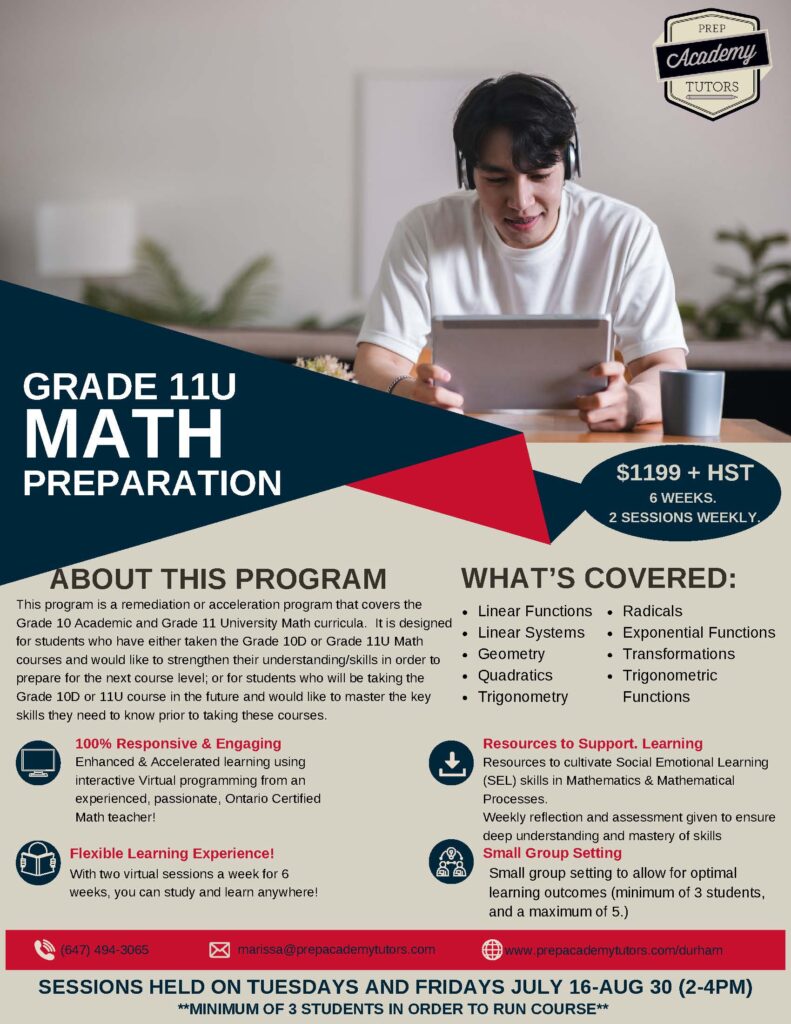
Intermediate Math Foundations